

by Dr. Mike Genualdi
Private Medical Silicon Valley Physician
For years, dementia has been framed as something that simply happens to us. The evidence now supports a more active view.
In its 2024 report, the Lancet Commission identified 14 modifiable risk factors that together may account for up to 45% of dementia cases worldwide. That figure is a population-level estimate, rather than a promise that any individual can eliminate nearly half of their personal risk. Age, biology, genetics, and chance still matter. It does mean, however, that dementia is not solely an inherited or inevitable consequence of aging. A meaningful portion of risk is connected to health conditions and exposures that can be proactively identified and addressed. This reframes the question from whether dementia can be prevented, to what can be done now, at whatever age a person happens to be.
About Dr. Mike Genualdi Dr. Michael Genualdi is a board-certified internist and Stanford-trained geriatrician who brings clinical rigor and a deeply personal perspective to long-term health. At Private Medical, he looks beyond symptoms and test results to build a thoughtful, highly personalized strategy designed to protect each member’s health, preserve vitality and support the life they want to lead. |
Brain health is whole-person health
One of the clearest lessons from the research is that the brain cannot be managed in isolation. A healthy cardiovascular system keeps the brain supplied with oxygen and nutrients. Hearing and vision determine how fully the brain remains connected to the world. Sleep, mood, movement, metabolism, and relationships all influence cognitive resilience. Traumatic brain injury, excessive alcohol and tobacco use, and air pollution appear on the Commission’s list as well, and each is addressed through ordinary preventive attention rather than anything exotic.
Effective prevention therefore looks less like a single “brain hack” and more like thoughtful, longitudinal primary care.
Prevention begins earlier than most people expect
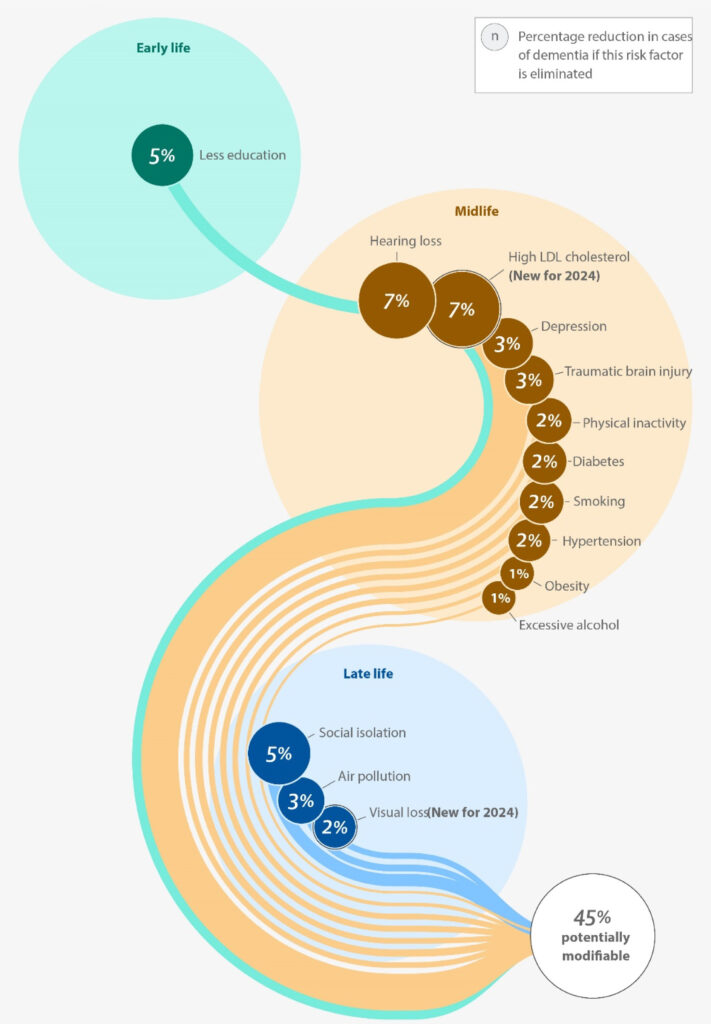
Source: Livingston G, et al. “Dementia prevention, intervention, and care: 2024 report of the Lancet standing Commission.” The Lancet. 2024.
The largest early-life factor in the Lancet model is not a medication or a test. It is education. Less education in early life accounts for an estimated 5% of dementia cases worldwide, a contribution equal to social isolation in later life and second only to hearing loss and high LDL cholesterol.
The underlying mechanism here is the building of cognitive reserve. Years of learning appear to build structural and functional capacity that allows the brain to tolerate more pathology before function declines. The Commission’s first recommendation is that all children receive good quality education, and its evidence suggests that cognitive activity continues to matter in midlife even for people who received relatively little formal schooling. While cognitive reserve is built early, the process does not end at graduation.
Two other early-life exposures deserve mention because they are so directly actionable for families. Traumatic brain injury accounts for an estimated 3% of cases, and the Commission specifically recommends helmets and head protection in contact sports and on bicycles. Air pollution accounts for another 3%. For parents weighing which youth sports to encourage, or where a family spends its time, these are not abstract considerations. They are among the few dementia risk factors that are modified almost entirely in the first two decades of life.
Optimizing cardiovascular care
Elevated blood pressure, high LDL cholesterol, diabetes, obesity, smoking, and physical inactivity all appear on the Commission’s list. Their importance is practical: they are measurable, treatable, and often present years before cognitive symptoms.
The SPRINT MIND trial offers especially useful evidence, and it also illustrates why precision matters. Among adults with hypertension and elevated cardiovascular risk, treating toward a systolic pressure below 120 rather than below 140 reduced the combined risk of mild cognitive impairment and probable dementia over roughly seven years of follow-up, and reduced mild cognitive impairment on its own. While the effect on probable dementia alone did not reach statistical significance, the direction of the finding still favored treatment, and the trial had been stopped early once the cardiovascular advantage became clear, leaving fewer dementia diagnoses to analyze than the question really deserved. The honest reading here is a strong signal for cognitive impairment and a suggestive one for dementia itself. The broader message holds: heart health can directly impact brain health, and the two are best managed as one.
The same is true of cholesterol and glucose management. What shapes risk is less about any single reading than about cumulative lifetime exposure. This is why the benefit of getting these elements optimized early compounds over time. A personalized approach may include nutrition, exercise, medication, or more likely a combination of all three. The goal is not to chase a universal number. It is to understand an individual’s total vascular and metabolic risk, then manage it consistently over time, adjusting as circumstances and evidence change.
Sensory input is critical
Untreated hearing loss is among the largest modifiable factors in the Lancet analysis, accounting for an estimated 7% of cases, tied with high LDL cholesterol. Untreated vision loss, newly added to the Commission’s list in 2024, accounts for an estimated 2%. Sensory changes are sometimes treated as quality-of-life issues rather than brain health issues. That distinction is increasingly difficult to defend.
When hearing or vision declines, people may participate less fully in conversation, movement, work, and community life. The brain receives less stimulation, and isolation and inactivity may increase.
The ACHIEVE randomized trial shows both the promise and the limits of intervening. In a pre-specified analysis, it slowed three-year cognitive decline by roughly half among participants already at higher risk, with no measurable effect in healthier volunteers recruited separately. The appropriate takeaway is measured but actionable: difficulty following conversation, especially in noise, deserves an evaluation, and so do correctable vision changes. Sensory care is part of preventive care.
Build healthy habits, not a perfect routine
Several major trials have tested multidomain programs that combine exercise, nutrition, cognitive challenge, social engagement, and cardiovascular risk management. The original FINGER trial in Finland demonstrated improved cognitive performance on its primary outcome. Australia’s Maintain Your Brain trial showed that personalized online coaching could also improve cognitive outcomes over three years.
The more recent US POINTER trial found that a structured lifestyle program outperformed a self-guided version of the same program over two years. That comparison deserves care, because it is widely over-read. Both arms received an active intervention, with no untreated comparison group, so some of the improvement seen in each likely reflects growing familiarity with repeated cognitive testing. What the trial establishes is that greater structure and accountability produced a measurable advantage over doing it alone. It does not establish the size of either program’s benefit against doing nothing at all, and the accompanying editorial noted that the clinical significance of the difference remains uncertain.
No single component explains the entire effect. That is the point. The brain benefits from a system of mutually reinforcing habits:
- Move consistently. Aim toward at least 150 minutes of moderate activity each week, adjusted for health, fitness, and mobility. Include strength, balance, and aerobic work rather than relying on one mode alone.
- Eat for long-term vascular health. A Mediterranean or MIND-style pattern emphasizes leafy greens, colorful vegetables, berries, beans, nuts, whole grains, fish, and extra-virgin olive oil while limiting heavily refined foods, added sugars, and high-saturated-fat meats. This is the dietary pattern used in the US POINTER and Maintain Your Brain programs, and it is the same pattern recommended for cardiovascular health.
- Protect sleep. Seven to eight hours is a useful general target, but sleep quality matters as much as duration. Persistent insomnia, loud snoring, witnessed pauses in breathing, or daytime sleepiness should prompt evaluation. Untreated sleep apnea is detrimental to both brain and heart health, and is readily treatable.
- Keep learning and connecting. Cognitive challenge is most useful when it is active and novel: learning a language, playing music, studying a new subject, or mastering a skill. Regular contact with family, friends, colleagues, or community adds a separate protective dimension. The important thing is to find something that you actually enjoy, and engage in it regularly.
- Take care of your mental health. Depression is linked with dementia risk, although the relationship may run in both directions. Either way, your mental health deserves as much attention and care as your physical health. They are intimately linked.
Review what is in the medicine cabinet
Medication stewardship is an underused part of brain health. Long-term or cumulative exposure to strong anticholinergic medications, including certain older antidepressants, bladder medicines, and over-the-counter sleep and allergy products, has been associated with higher dementia risk in large cohort studies, with risk rising alongside cumulative dose. Long-term use of benzodiazepines, certain sedative-hypnotics, and high-dose opioids also warrants careful review, although reverse causation and other confounding factors complicate the evidence.
This is not a reason to stop medication abruptly. It is a reason to review the full medication list, including nonprescription sleep and allergy products, with your physician, who can weigh benefits, alternatives, dose, duration, and interactions. Sometimes the most meaningful intervention is not adding something new, but reducing unnecessary cognitive burden.
Emerging treatments deserve the same rigor, and they are also where some of the most interesting work in medicine is happening right now. GLP-1 medications are a good example. Several large observational studies of people with type 2 diabetes have found meaningfully lower rates of dementia and Alzheimer’s disease among those treated with these agents, which is a promising signal. At the same time, two large phase 3 trials in people who already had early symptomatic Alzheimer’s disease, most with mild cognitive impairment rather than established dementia, did not show slowing of cognitive or functional decline.
The most likely explanation for the gap is timing: treating a disease that has already taken hold is a different proposition than influencing risk years before symptoms appear, and the trials tested the former. That question, whether these medications affect risk when started earlier in the right person, is still open and actively being studied.
So GLP-1 medications are not a dementia-prevention therapy today, and we would not prescribe one on that basis. But this is a fast-moving area, and we follow it closely. Part of what we do is track this literature as it develops so that our members are neither chasing headlines nor waiting years to hear about evidence that has already changed. When something moves from promising to proven, we want to be having that conversation early.
Menopausal hormone therapy sits in similar territory. There are good reasons many women consider it, and cognitive symptoms during the menopausal transition are real and deserve to be addressed. The point of caution is narrower than it is sometimes made to sound: dementia prevention alone is not a sufficient reason to start hormone therapy, because the evidence there is mixed and highly dependent on age, timing, and formulation. That is different from saying hormone therapy is off the table.
This is a decision that deserves a real conversation, and ideally a three-way one, involving you, your physician, and your gynecologist together. Symptoms, age, time since menopause, cardiovascular and breast cancer risk, personal priorities, and the specific formulation under consideration all belong in that discussion. At Private Medical, our gynecologists work directly alongside our internists precisely so this kind of decision can be made in concert rather than in separate appointments that never quite connect.
Genes influence risk; they do not write the entire outcome
Many of our members want to know everything about their bodies, and APOE testing comes up often. That instinct is a reasonable one, and the answer is not simply yes or no. It is that the value of the test depends almost entirely on the conversation surrounding it.
APOE ε4 is associated with a higher risk of Alzheimer’s disease, but multiple studies suggest that healthy lifestyle patterns remain beneficial in carriers and noncarriers alike. In both the FINGER and US POINTER trials, cognitive benefits were not meaningfully diminished by APOE ε4 status. The Commission reaches the same conclusion: risk appears modifiable irrespective of APOE genotype. Rather than rendering genetics irrelevant, these findings demonstrate the importance of prevention when inherited risk is present.
Here is what an APOE result can tell you. It identifies whether you carry one or two copies of the ε4 variant, which is associated with higher lifetime risk of Alzheimer’s disease and, on average, earlier onset. That is real information, and for some people it is powerfully motivating. It can sharpen the case for addressing blood pressure, cholesterol, sleep, hearing, and activity now rather than later. Some members also want it for family planning conversations, or simply because they would rather know than not know.
Here is what it cannot tell you. It is not diagnostic and it is not deterministic. Many ε4 carriers never develop Alzheimer’s disease, and many people who develop the disease carry no ε4 copies at all. The test cannot tell you whether you will develop dementia, or when. It also cannot be undone – once you know, you know, and that knowledge extends to blood relatives who may not have chosen it for themselves. Results can carry implications for certain kinds of insurance, which is worth understanding in advance rather than discovering afterward.
The honest reality is that the prevention plan for an ε4 carrier and a noncarrier looks remarkably similar, for the reasons described above. What changes is often intensity and timing rather than direction: a carrier may reasonably choose to be more aggressive about vascular risk earlier, to pursue hearing and vision evaluation sooner, or to establish cognitive baselines while entirely well.
So the question I ask before testing is not whether you can handle the result. It is what we would do differently with each possible answer, and how you think you would feel receiving each one. If we can answer that together beforehand, testing is often worth doing and we will support it. If the answer is that nothing would change, that is worth knowing too. Either way, the test should come with a plan attached, and you should never receive a result like this without someone who knows you sitting on the other side of it.
Where science is still evolving
Lifestyle trials have shown improvements in cognitive performance and, in some settings, lower rates of mild cognitive impairment. They have not yet demonstrated that multidomain programs reduce the number of people who ultimately receive a dementia diagnosis. Some trials have also been negative. Effects seen over two or three years may or may not translate into durable protection over decades.
That limitation should temper the promise, not erase the value. The recommended actions, including controlling vascular risk, moving regularly, eating well, sleeping, treating depression and sensory loss, avoiding tobacco and head injury, and staying connected, support overall health even if their exact effect on dementia incidence remains uncertain.
A practical place to begin
A brain health plan should be built around you, not assembled from a template. But the first conversation is usually straightforward, and these are the questions I find most useful to work through together:
- Where do your numbers actually stand? Blood pressure, LDL cholesterol, glucose, and overall cardiovascular risk. Not just whether they are flagged abnormal, but what they mean in the context of your age, family history, and trajectory over time.
- Is anything getting in the way of how you engage with the world? Hearing and vision changes are easy to accommodate without noticing, sometimes for years. Both are worth evaluating routinely, and both are straightforward to treat.
- What does your lifestyle look like? Movement, sleep, food, mood, alcohol, tobacco, and time with people you care about. I would rather know what is actually happening than what we both wish were happening. The goal is not judgment, but collaboration from an accurate picture.
- What is in your medicine cabinet? Every prescription, supplement, and over-the-counter product, including the sleep and allergy items most people forget to mention.
- What would you most like to protect? The travel, the work, the grandchildren, the instrument you still play. Prevention is easier to sustain when it is attached to something specific you want to keep doing.
- How do we build a sustainable plan? Two or three priorities you can realistically maintain will outperform a comprehensive overhaul that collapses in six weeks. We can always add. Revisiting these together over time matters more than getting the first list perfect.
If you are a member and want to work through this, bring it up at your next visit or simply reach out. This is exactly the kind of conversation we have time for, and none of it needs to wait for something to be wrong.
The most hopeful message in dementia-prevention research is not that risk can be reduced to zero. It is that brain aging is shaped, in part, by the same careful medical management and sustainable daily choices that protect the rest of the body. The work begins long before symptoms appear, and it remains worthwhile at every age.
Selected evidence
- Livingston G, et al. Dementia prevention, intervention, and care: 2024 report of the Lancet standing Commission. The Lancet, 2024.
- Ngandu T, et al. A 2 year multidomain intervention of diet, exercise, cognitive training, and vascular risk monitoring versus control to prevent cognitive decline in at-risk elderly people (FINGER): a randomised controlled trial. The Lancet, 2015.
- Baker LD, et al. Structured vs Self-Guided Multidomain Lifestyle Interventions for Global Cognitive Function: The US POINTER Randomized Clinical Trial. JAMA, 2025.
- Brodaty H, et al. An online multidomain lifestyle intervention to prevent cognitive decline in at-risk older adults: a randomized controlled trial (Maintain Your Brain). Nature Medicine, 2025.
- SPRINT MIND Investigators. Long-Term Effect of Intensive vs Standard Blood Pressure Control on Mild Cognitive Impairment and Probable Dementia in SPRINT. Neurology, 2025.
- Lin FR, et al. Hearing intervention versus health education control to reduce cognitive decline in older adults with hearing loss in the USA (ACHIEVE): a multicentre, randomised controlled trial. The Lancet, 2023.
- Gray SL, et al. Cumulative Use of Strong Anticholinergics and Incident Dementia: A Prospective Cohort Study. JAMA Internal Medicine, 2015.
- Coupland CAC, et al. Anticholinergic Drug Exposure and the Risk of Dementia: A Nested Case-Control Study. JAMA Internal Medicine, 2019.
- Cummings JL, et al. Efficacy and safety of oral semaglutide 14 mg in early-stage symptomatic Alzheimer’s disease (evoke and evoke+): two phase 3, randomised, placebo-controlled trials. The Lancet.
- Wang W, et al. Associations of semaglutide with Alzheimer’s disease-related dementias in patients with type 2 diabetes: a real-world target trial emulation study, 2025.
Editorial note: This article is educational and should not be read as individualized medical advice. Medication changes and treatment targets should be discussed with a physician.